Archive Page 3

Brahms Clarinet Quintet, Movt. 2

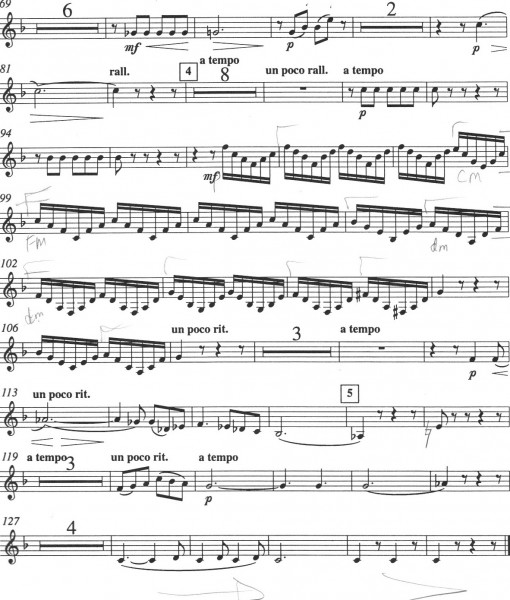
Here’s the second movement of the Brahms Quintet Op. 115 in B minor, written in 1891. The gypsy Brahms shows heavily in the middle of the piece, and then he smooths out his shirt and the music goes back to the sublime mood of the beginning. I particularly love the coda of this movement, when the clarinet floats (hopefully) up to the high d.

Audio clip: Adobe Flash Player (version 9 or above) is required to play this audio clip. Download the latest version here. You also need to have JavaScript enabled in your browser.

  • Share/Bookmark

Siroccos, Gremlins and Brahms

Tonight’s Columbus Symphony concert went well.

The difficult passages in the Sierra “Fandangos” were, as I expected, mostly for “effect”, meaning the notes themselves didn’t matter as much as the shape and volume of the passage. Delfs used the word “Sirocco” to describe the blurs of loud runs. A Sirocco is a “hot or warm wind of cyclonic origin from an arid or heated region.” The piece overall was entertaining and colorful, and used the orchestra effectively. I can see why Sierra has gotten some attention as a composer.

Andre Watts performed the Beethoven Emperor piano concerto like a seasoned pro. His famously full tone on the piano transformed the piece into something larger than life. Delfs followed his lead with a rich and full accompaniment, which few pianists could cut through, but Watts had no trouble.

Unfortunately, the concentration of both performers and listeners was annoyed by a high pitched whine from a hearing aid or some other electronic device. Delfs even spoke to the audience between movements, requesting the owner of offending hearing aid to turn it off.

The incident reminded me of similar event I experienced a few years ago. It occurred at a concert of Bach’s St. Matthew Passion which I attended at the Kennedy Center. A guide-dog, which accompanied a listener in the audience, didn’t like the music being played, and whined through several movements. The conductor did not stop and request that it cease immediately, but the animal and its owner were asked to leave during intermission. Yet the entire audience had to withstand a substantial distraction during an otherwise stellar concert. It raises thorny questions about the limits of inclusiveness at concerts.

I had forgotten how tricky Beethoven concertos could be. His 1st piano concerto has a lengthy clarinet solo in the slow movement. His violin concerto has another such delicate and difficult solo. Tonight’s concerto, the 5th and last concerto he wrote for piano, has yet another dicey part, difficult to tune and phrase, especially at the dynamics Beethoven requests. Yet I felt better than usual about it, armed as I am now with Legere synthetic reeds, which don’t collapse under the stresses of heat and tense playing. After the concerto, I commented to my colleague Woody that I had never felt so (relatively) comfortable in a performance of that piece.

The second half featured Brahms’ magnificent 2nd symphony, which a friend of mine claims is his best. It’s Brahms’ “happiest” symphony, with cheerful themes throughout. Yet I never fail to be amazed at Brahms’ rich and dense score. In my view, there is more music packed in each measure of Brahms than any other composer. It’s as if he wrote a piece two hours long, and then somehow condensed the same emotions into 45 minutes. Delfs’ traditionally expansive reading allowed us to feel and explore much of the hidden detail.

As for my own experience, I was a happy clam. I had settled just this week on playing my Hawkins B mouthpiece. I had not played it much with the Legere reeds, but after I grew accustomed to the combination, I was quite happy. For the first time in years, I felt and heard the resonance of my own sound coming back to me from the hall. Remember, the Ohio Theater is quite large, 2800+ seats, and not a particularly resonant hall. Much of the sound just bounces around the boxy stage. But I remember the comfort of knowing I had filled the hall with my sound, when I was playing on my old Lelandais in its heyday before it lost its integrity. Tonight I felt that resonance again. Hallelujah!

As for Gremlins, they exist. They will creep into a passage and throw a few notes off, just for gremlin fun. As any seasoned orchestra player will tell you, if one person gets a gremlin, they are sure to bounce around to a few other players before ceasing. There were a few gremlins tonight, but nothing Brahms’ glorious music couldn’t handle.

  • Share/Bookmark

Naughtiest Composer, so far

This weekend the Columbus Symphony is playing a symphonic concert featuring pianist Andre Watts in Beethoven’s 5th Concerto, Emperor. Andreas Delfs, former music director of the Milwaukee Symphony, leads us in Johannes Brahms’ 2nd Symphony in D Major.

Delfs had some interesting comments during our rehearsal of the Brahms today. At one point, wanting to urge us to play particularly passionately in one place, he said “You never know how many people in the audience are hearing this for the first time.” I agree. And his comfortable familiarity with the piece promises a rich and noble reading.

To open the concert, we are playing something new to us, Roberto Sierra’s Fandangos, written in 2000.

Mr. Sierra, Puerto Rican, was born in 1953. He studied in Europe, notably with György Ligeti, a well known avant-garde composer, whose music was featured famously in the move 2001 A Space Odyssey.

Fandangos has some passages which are, for all practical purposes, unplayable. The photo below shows the first page, listing the tempo at quarter equals 96, the second photo shows the passages in question. Notice also that the first page also says “Improvisatorio, and a bit later “con garbo”, meaning “jauntily”. The possessed passages will definitely sound improvised, and not just a little bit jaunty.

Dear Mr. Sierra, what were you thinking? Why did you write such fiendish licks for us? Musicians are good creatures, never wishing to harm anyone, except themselves. Did a musician mistreat you at a tender age? What did we do to deserve banishment to the guilt-riddled purgatory of failing to play exactly what is written? Please, send me a list of clarinetists who can play these licks perfectly, and I’ll show you a clarinetist like the technical genius monster Kari Krikku, or another once in a generation player.

So Mr. Roberto Sierra get the “Naughtiest Composer so far” award.

  • Share/Bookmark

Brahms Clarinet Quintet, Movt. 1

We clarinetists are lucky, we’ve got 4 major works for clarinet written by Johannes Brahms: the Trio in A minor for clarinet, cello and piano, Op. 114; the Quintet in B minor for clarinet and strings, Op. 115; and Sonatas Nos. 1 and 2, Op. 120. His association with clarinetist Richard Mühlfeld gave the world some great music, and clarinetists some of their best. Too bad he didn’t write a concerto for clarinet.

Here’s the first movement of the quintet, with that silky lullaby main theme. I was privileged to performed this with my fine colleagues from the Columbus Symphony a number of years ago. I was playing my Lelandais mouthpiece, for those interested.

Written for the A clarinet, Brahms explored the dark lower range of the instrument. He also featured the clarinet’s gypsy side in the second movement which I’ll post in a few days.

Audio clip: Adobe Flash Player (version 9 or above) is required to play this audio clip. Download the latest version here. You also need to have JavaScript enabled in your browser.

  • Share/Bookmark

The Many Hats of a Musician

As my colleague Betsy Sturdevant pointed out in a recent post on her Bassoon Blog, the Columbus Symphony has a busy schedule with wildly varied repertoire this weekend.

Actually Betsy and I have a particularly full weekend, since we are both playing at a fundraiser for the Columbus Symphony, and which takes place after a relatively full day of a rehearsal and “Meet the Orchestra” Family concert Sunday afternoon. I plan to play the Rachmaninoff Vocalise and an arrangement of a Chopin Nocturne, No. 20, Op Posthume. These slow, songful pieces will nicely balance the virtuosic Vogel piece Betsy plans to play, a mini-concerto for bassoon and three strings.

However, before that all happens, we have a pops concert tonight featuring jazz singer Dianne Reeves. Dianne’s voice has a gorgeous, velvety tone, and her improvitory abilities are remarkable. Her singing range is huge, from throaty low notes to squeaky, flutey high tones. It’s a pleasure to hear her sing and play with her. Her arrangements, mostly by Billy Childs, are excellent, and the orchestrations are good as well.

The orchestra is featured on the first half of tonight’s program, with Jerry Steichen conducting. Included in the music are excerpts from “Harlem Symphony” by James P Johnson, the earliest African American symphonic composer.

There are some other tricky pieces, including several jazzy arrangements with clarinet solos. Dixieland bands were a traditional group for early jazz. To create that authentic sound, the orchestra drops out in a few spots, leaving clarinet alone with trap set playing rhythm and a string bass player, joined later by trumpet and trombone. The solos are written out, but the style, a light, perky, rhythmic freedom, is not. To help me get into the mood, I imagine I’m playing on an old scratchy 78 rpm record from the 20s, with the piercing and jaunty tone of an early jazz clarinetist.

Unfortunately, the training I received as a classical player did not include jazz improvising. If I were in charge of a university classical clarinet department, I would require all students to take an improvisation class, and to learn to play along with a few jazz recordings to get the style right.

We wear many hats as musicians, from baroque to classical to romantic to jazz to modern.

I often think of a story Clark Brody told me. He was was the principal clarinetist with the Chicago Symphony for 40 years or more. He was a great player. Yet he lamented that whenever his orchestra played Gershwin’s Rhapsody in Blue, he was unable to perform the proverbial glissando clarinet shmear which opens the piece. Now a days, that solo is on almost every audition list.

Times have changed, and so has the job of a principal clarinetist.

  • Share/Bookmark

Tweets for Dec 28-Jan 9

Facing your weaknesses as a player may also involve facing your own personal weaknesses.

Think of practicing as performing in a safe place.

Delightful and bravura Mendelssohn pieces for 2 clarinets & pno. Should be played more. http://cli.gs/DZX2P

Technical passages in music often need the most musical phrasing.

Emptiness, of space or mind, is where music resonates most.

Enjoy the silence of the space between the phrases.

Music is a reflection of the complex landscapes of the human spirit.

Friendship is the soul of love.

Try to notice the circular unity of your breath and carry that into your music making.

Listening to classical music is an intimate experience. Whom do you share it with?

Intensity of practice is measured by determination and persistence at most difficult points.

Music is a map of the rich landscapes of the human spirit.

Allow the silence of rests in phrases to be as important as the phrase itself.

Familiarity can cause blindness to what is truly valuable. Perspective is the cure.

Sadness in a song is part of its beauty. So also with life.

Quality of practice is measured by clarity of attention.

We must know our savage self to cultivate our civilized self.

You only borrow energy from life. One day you must return it. (from Avatar)

Weaknesses in playing can hide deep in your habitual use. Fresh patience daily.

Ironically, trying less can benefit more. Try it! http://cli.gs/y6gST

Overcoming weaknesses in playing can be a long, slow process, since they often hide in your playing tensions. Be patient.

  • Share/Bookmark

Klezmer like a fish in water

This guy has such physical ease, grace, facility on the instrument. Makes me want to dance. How about you? Anyone know who it is? I don’t read Hebrew.

This video was embedded using the YouTuber plugin by Roy Tanck. Adobe Flash Player is required to view the video.

  • Share/Bookmark


Switch to our mobile site